
Horse Colors
A horse’s body color does not always tell the whole story. A dark brown horse might be bay, chestnut, or a sun-faded black, while a white-looking horse may have been born with a much darker coat. To identify horse colors, compare the body with the mane, tail, and lower legs, then look for distinctive markings. Bay, chestnut, and black are the base coat colors; dilution, spotting patterns, and graying create many of the variations seen in horses.
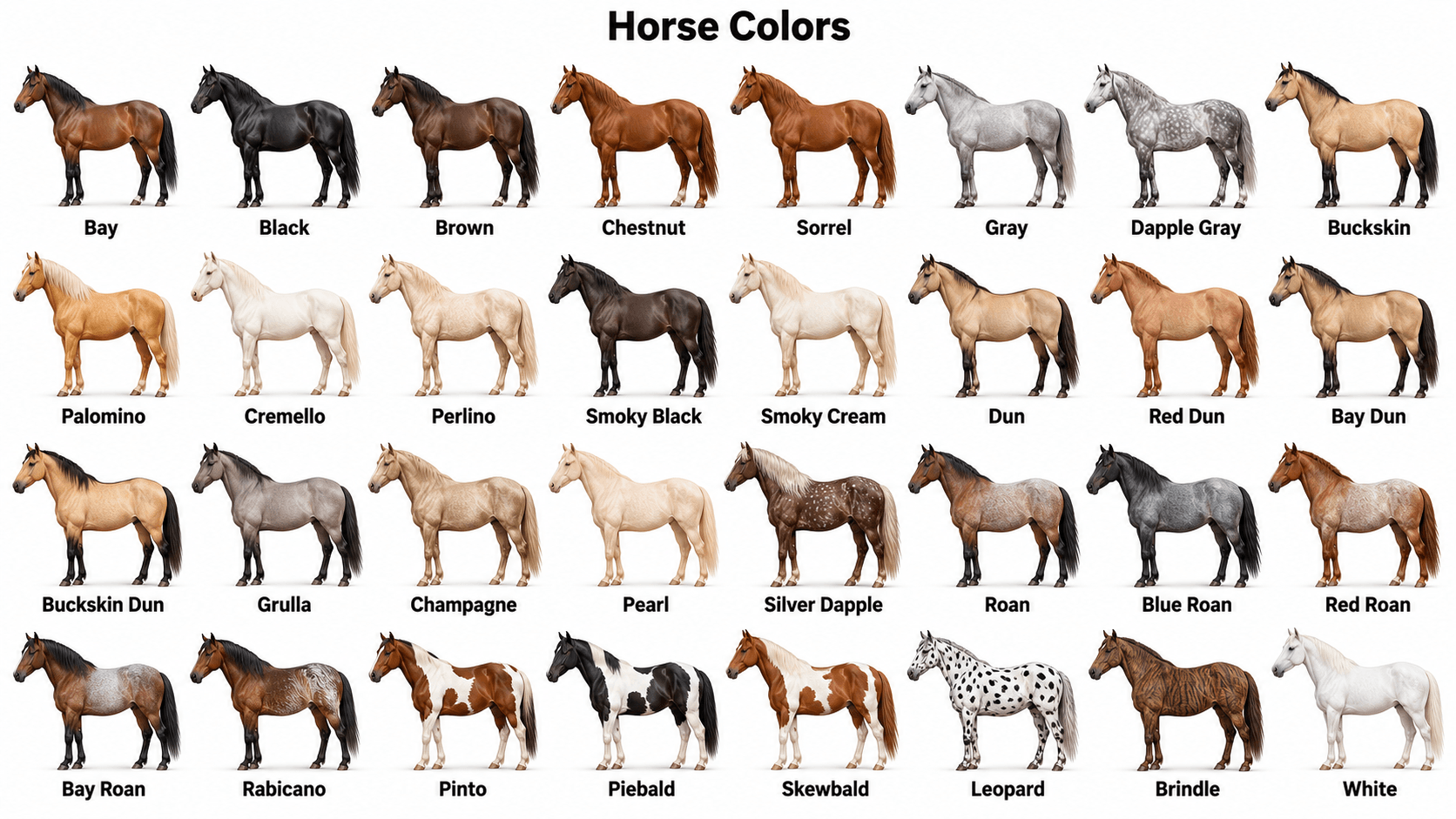
Horse Color Chart
This chart compares coat colors, shades, and patterns. Some names describe a genetic color, while others describe how a coat looks. Follow the linked names for detailed descriptions and pictures.
| Color or pattern | Typical appearance | Identifying features and variations |
| Bay Horse | Reddish-brown body with black points | Black mane, tail, and lower legs; shades include Dark Bay and Blood Bay |
| Black Horse | Black body, mane, and tail | Fading Black may turn brownish in sunlight; Non-Fading Black retains a darker appearance |
| Brown Horse | Brown to almost black | A variable descriptive term; check the muzzle, flanks, and points |
| Chestnut Horse | Red, copper, or deep reddish brown | No true black points; includes Basic Chestnut, Liver Chestnut, and Flaxen Chestnut |
| Sorrel Horse | Usually a reddish chestnut | Commonly used in American stock-horse terminology; usage varies by registry |
| Gray | Pigmented coat that progressively lightens | Descriptions include Salt and Pepper Gray, Fleabitten Gray, and Rose Gray |
| Dapple Gray Horse | Gray coat with rounded lighter and darker areas | Dappling can change as the horse ages |
| Buckskin Horse | Tan or golden body with black points | One copy of cream dilution on a bay background |
| Palomino Horse | Golden body with a pale mane and tail | One copy of cream dilution on a chestnut background |
| Cream dilution | Lightens pigment, with effects depending on the base color | One or two copies produce different coat color variations |
| Cremello Horse | Very pale cream coat | Double cream dilution on chestnut; typically pink skin and blue eyes |
| Perlino | Very pale cream, sometimes with warmer-colored points | Double cream dilution on bay |
| Smoky Black | Often looks similar to ordinary black | One cream copy on black; the visible effect can be slight |
| Smoky Cream | Very pale cream coat | Double cream dilution on black |
| Dun Horse | Lightened body with darker points and primitive markings | Includes Red Dun and Bay Dun; Buckskin Dun combines dun and cream dilution |
| Grulla Horse | Mouse-gray or smoky body with darker points | Also called grullo; dun dilution on a black background |
| Champagne | Gold or brown-toned dilution | Skin color and eye characteristics help distinguish it from similar dilutions |
| Pearl | Pale, often warm-toned coloring | Visible dilution generally requires two pearl copies or a pearl-and-cream combination |
| Silver Dapple | Lightened black pigment, often with a pale mane and tail | Dapples are not required; silver does not visibly dilute red pigment |
| Roan Horse | White hairs mixed through the colored body coat | Head and lower legs usually remain darker; includes Blue Roan, Red Roan, and Bay Roan |
| Rabicano | Scattered white hairs, especially around the flanks | White hairs near the tail base may create a ringed appearance |
| Pinto Horse | Substantial white and colored patches | Pattern descriptions include Tobiano, Overo, Sabino, and Tovero |
| Piebald Horse | Black and white patches | Piebald describes black-and-white coloring; Skewbald describes white with another color |
| Leopard complex | Variable white areas and spotting | Descriptions include Leopard, Blanket, Snowflake, Few Spot Leopard, Frost, and Varnish Roan |
| Brindle | Unusual striping across the coat | Appearance and genetic causes can vary |
| White | White or extensively white coat | Must be distinguished from gray horses and pale cream dilutions |
Horse Colors That Are Easy to Confuse
- Bay and chestnut: Both can have reddish-brown bodies. Look at the mane, tail, and lower legs: bay has black points, while chestnut does not. A flaxen chestnut has a lighter mane and tail, which can also lead to confusion with palomino.
- Buckskin and dun: Both may have tan bodies and darker points. Dun typically adds primitive markings, but a stripe along the back alone does not confirm it. Some non-dun horses have similar-looking countershading, and buckskin dun horses carry both dilutions.
- Gray and roan: Gray progressively lightens the coat with age. Classic roan mixes white and colored hairs through the body while usually leaving the head and lower legs darker. Varnish roan belongs to the leopard complex and should be distinguished from classic roan.
- White and pale cream: Cremello, perlino, and smoky cream can look nearly white. Birth color, skin pigmentation, eye color, and genetic testing help distinguish pale dilutions from gray or genetically white horses.
What Determines a Horse’s Coat Color?
Horse coat color is inherited through interacting genes. The extension gene, MC1R, affects red and black pigment production, while Agouti controls the distribution of black pigment. Other genetic modifiers produce dilution, white spotting, and progressive graying.
Mushroom is a recognized dilution; Sooty, Pangaré, and Flaxen describe additional coat effects whose genetic explanations are not equally established. The UC Davis Veterinary Genetics Laboratory guide to equine coat colors explains the main genetic relationships and when testing can clarify an uncertain identification.
Check the whole horse rather than judging its body shade alone. The mane, tail, lower legs, white patterns, and changes with age help narrow down the color. Use the chart for a quick comparison and the individual color guides for a closer look; when appearances overlap, genetic testing can provide a clearer answer.